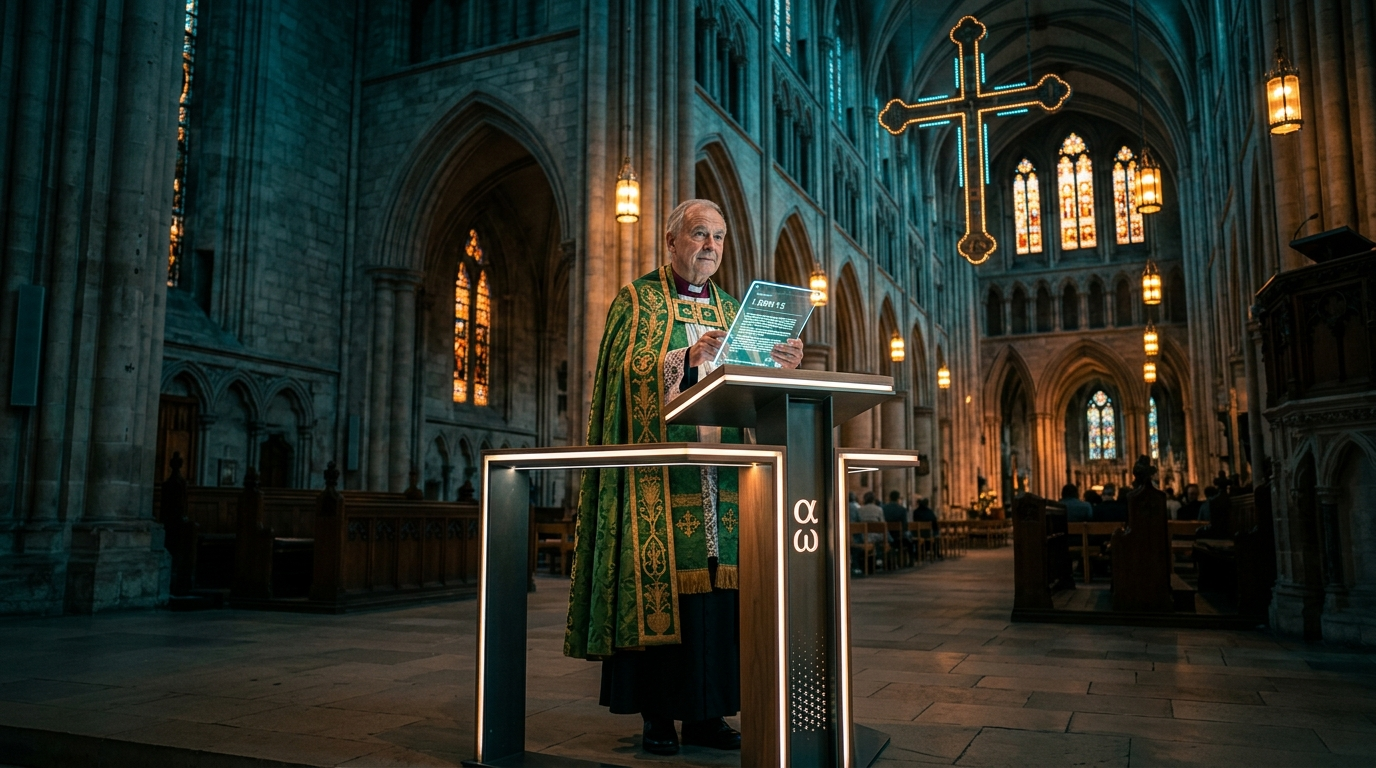
Church Resources
How to Use Visual Scripture in Your Sermon Series: A Practical Guide for Pastors
How to Use Visual Scripture in Your Sermon Series: A Practical Guide for Pastors
By the Bible with Life Editorial Team | March 2026 | Church Resources
TL;DR: Pastors spend an average of 11–18 hours preparing each sermon — but most of that time goes into words, not visuals. Research from the American Bible Society (2025) shows that two-thirds of Bible users now access Scripture digitally, and Bible engagement is described as "fully multimedia." This guide shows how to integrate cinematic visual Scripture into your sermon series without adding to your prep time.
The Sermon Has Always Been Visual — We Just Forgot
The ancient synagogue had no screens. But it had something more powerful: a reader who stood before the community, unrolled the scroll, and performed the Word. The text was not merely transmitted — it was embodied, dramatized, made present.
For most of church history, preaching was the primary visual medium. The preacher's voice, gestures, and presence carried the full weight of the narrative. Then came the printing press, and Scripture became a private, silent, text-on-page experience. The visual dimension of biblical storytelling was gradually lost.
Now it is coming back — and the data confirms it.
According to the American Bible Society's State of the Bible USA 2025, two-thirds of Bible users now access Scripture digitally, and the report explicitly states that "Bible Engagement is now fully multimedia." This is not a trend. It is a completed transition.
The question for pastors is no longer whether to use visual media in their sermon series. It is how to do it well.
Why Sermon Series Are the Right Unit for Visual Scripture
A standalone sermon can work without visuals. A sermon series cannot afford to.
Here is why: sermon series are how churches build sustained engagement over multiple weeks. They are how pastors develop theological themes, walk through entire books of the Bible, and create the kind of cumulative understanding that produces genuine discipleship.
But sustained engagement requires sustained attention — and sustained attention in 2026 requires visual anchoring.
The research is clear on this point:
- Pastors in growing churches spend an average of 20 hours per week on sermon preparation, compared to just 2 hours for pastors in declining churches, according to research cited by Carey Nieuwhof. The difference is not just more words — it is more craft, including the visual and narrative dimensions of communication.
- The American Bible Society (2025) found that flourishing increases with frequency of Bible use, and that Bible Study Groups "prove helpful" — but only when participants have a shared reference point. Visual Scripture creates that shared reference point across a multi-week series.
- Barna's 2024 research found that 88% of pastors are willing to use AI for graphic design and visual content in ministry. The appetite for visual tools is already there. What most churches lack is a source of visual Scripture content that meets the theological standard the sermon requires.
The 5-Step Framework: Visual Scripture in a Sermon Series
Step 1: Choose Your Series Arc Before You Choose Your Visuals
The most common mistake churches make is treating visual media as decoration — something added after the sermon is written. This produces visual content that is generic, disconnected from the text, and quickly forgotten.
The better approach: define your series arc first, then select visual Scripture that carries the arc.
For example:
- A series on the life of David needs visuals that move from shepherd fields to the palace to exile — not generic "worship" imagery
- A series on the Gospel of John needs visuals that track the "I Am" statements — bread, light, vine, resurrection
- A series on Revelation needs visuals that distinguish between the letters to the seven churches and the apocalyptic visions
Free 7-Day Journey
Go Deeper Into Scripture
7 cinematic devotionals delivered to your inbox — one story, one verse, one life-changing truth per day.
No spam. Unsubscribe anytime.
When your visual Scripture is chapter-specific and narratively coherent, it does theological work that your words alone cannot do.
Step 2: Use the Opening Visual as a Hermeneutical Frame
The first 90 seconds of a sermon determine whether your congregation is with you or not. This is not a media strategy — it is a cognitive reality.
Research on dual-coding theory (Paivio, 1971, updated extensively through neuroscience) consistently shows that information presented in both verbal and visual channels is retained at significantly higher rates than information presented in either channel alone. When a congregation sees a cinematic rendering of the passage before you begin to preach, they arrive at your first point with a mental image already formed.
This is not entertainment. It is pedagogy.
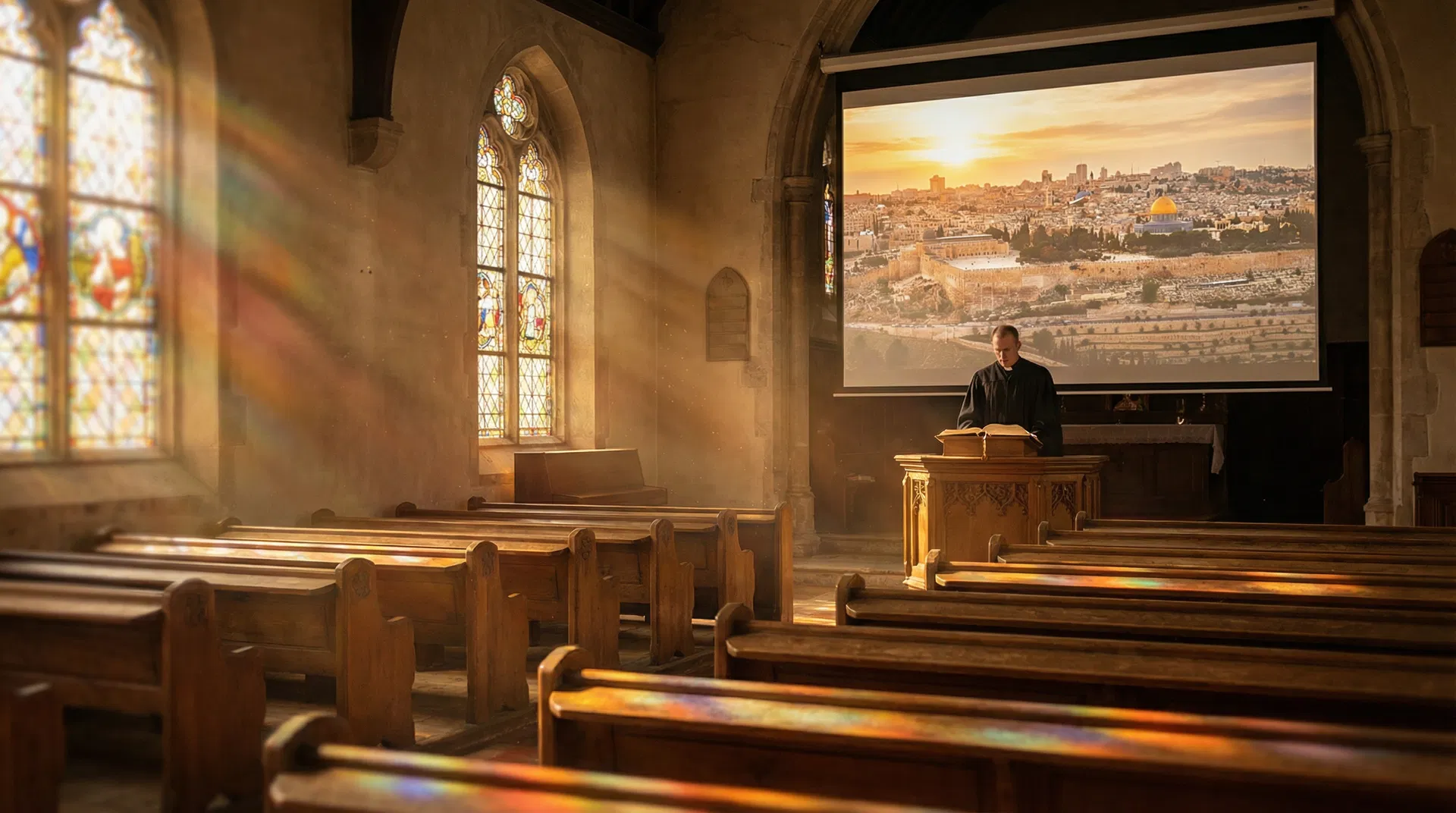
Practical application: Open each week of your series with a 2–3 minute cinematic chapter segment. Do not explain it. Let it speak. Then begin your sermon. The visual has already done the hermeneutical work of placing the congregation inside the world of the text.
Step 3: Match Visual Chapters to Your Preaching Outline
Not every sermon series requires a visual for every point. But every series benefits from having a visual anchor at the turning points of the narrative.
For a 6-week series on the Gospel of Mark, for example:
| Week | Text | Visual Anchor |
|---|---|---|
| 1 | Mark 1:1–20 | The Baptism and Calling of the Disciples |
| 2 | Mark 2:1–12 | The Healing of the Paralytic |
| 3 | Mark 4:35–41 | The Calming of the Storm |
| 4 | Mark 8:27–38 | Peter's Confession at Caesarea Philippi |
| 5 | Mark 14:32–52 | Gethsemane |
| 6 | Mark 16:1–8 | The Empty Tomb |
Each visual anchor is a chapter-level cinematic rendering of the passage — not a stock photo, not a generic cross image, but a scene that places the congregation inside the narrative world of the text.
Step 4: Use Visuals for Congregational Takeaways, Not Just Pulpit Moments
One of the most underused applications of visual Scripture is the post-service distribution.
When a congregation member can watch the same cinematic chapter they saw in church during the week — on their phone, in their small group, with their family — the sermon continues working. The visual becomes a shared reference point that extends the preaching moment into the week.
The American Bible Society (2025) found that flourishing increases with frequency of Bible engagement, not just intensity. A single powerful sermon experience is valuable. A sermon experience that is reinforced throughout the week through visual Scripture is transformative.
Practical application: At the end of each sermon, display the QR code or URL for the cinematic chapter library. Encourage your congregation to watch the chapter again during the week. Include it in your weekly email. Feature it in your small group guide.
Step 5: Evaluate Visual Scripture by Theological Standard, Not Production Value
This is the most important step — and the one most churches skip.
Not all visual Scripture is created equal. The question is not "does it look good?" The question is "does it accurately represent the text?"
Barna's 2023 research found that more than half of Christians would be disappointed to learn their church uses AI-generated content. The concern is not about technology — it is about theological integrity. Congregations are right to ask whether the visual representation of Scripture is faithful to the narrative, the historical context, and the theological weight of the passage.
When evaluating visual Scripture for your sermon series, ask:
- Narrative accuracy: Does the visual represent what the text actually says, or does it add or subtract from the narrative?
- Historical plausibility: Does the visual reflect the first-century context of the text, or does it impose modern or anachronistic imagery?
- Theological weight: Does the visual capture the emotional and theological gravity of the passage, or does it flatten it into generic religiosity?
- Cultural sensitivity: Does the visual represent the diversity of the biblical world, or does it default to a single cultural aesthetic?
These are not abstract questions. They are the same questions your congregation will be asking — consciously or not — as they watch.
Common Objections — and How to Answer Them
"Our congregation is traditional. They don't want screens."
The research does not support this assumption. Barna (2024) found that 88% of pastors across all church types — including traditional and liturgical churches — are willing to use visual content for ministry purposes. The resistance is not to visuals per se; it is to visuals that feel cheap, distracting, or theologically thin.
High-quality, chapter-specific visual Scripture is different from stock footage of sunsets and crosses. When congregations see the actual narrative of Scripture rendered cinematically, the response is almost universally positive — because it serves the text rather than replacing it.
"We don't have the budget for professional media production."
This objection is increasingly obsolete. The question is not whether your church can produce visual Scripture — it is whether your church can access visual Scripture that has already been produced to a professional standard.
The economics of visual Scripture have changed. What once required a full production team and a six-figure budget is now available as a subscription resource — with the same cinematic quality that your congregation sees in documentary films and streaming series.
"I'm worried about copyright and licensing."
This is a legitimate concern. Any visual Scripture resource you use in a church setting should come with a clear licensing agreement that covers public display, small group use, and digital distribution.
Before selecting a visual Scripture resource for your sermon series, confirm:
- Public display rights (for use in the sanctuary)
- Small group rights (for use in homes and community spaces)
- Digital distribution rights (for use in email, social media, and your church app)
A Practical Checklist for Your Next Sermon Series
Before your next series begins, work through this checklist:
- Series arc defined: Do you have a clear narrative arc for the full series?
- Visual chapters identified: Have you identified the specific chapters that will serve as visual anchors for each week?
- Theological review complete: Have you watched each visual chapter and confirmed it accurately represents the text?
- Licensing confirmed: Do you have the rights to display the visual Scripture in your sanctuary, small groups, and digital channels?
- Congregation touchpoints mapped: Have you identified how your congregation will access the visual Scripture during the week (QR code, email, small group guide)?
- Evaluation criteria set: Have you defined what "success" looks like for the visual dimension of this series?
Where to Start
The most practical starting point is a single series — not a full-year commitment, not a complete overhaul of your media strategy. Choose one series, identify three to four visual chapter anchors, and experience the difference in congregational engagement firsthand.
Bible with Life has produced cinematic, chapter-by-chapter visual Scripture for over 115 chapters across the Old and New Testaments. Every chapter is theologically reviewed, historically grounded, and produced to a cinematic standard that meets the visual expectations of a screen-native generation.
Browse the Visual Scripture Chapter Library →
If you are planning a series and want to identify which chapters are available for your specific text, the full library is organized by book and chapter — making it straightforward to build your visual sermon series plan.
Download a Free Sermon Series Starter Kit →
The starter kit includes sample visual chapters, a sermon series planning template, and licensing information for church use.
Conclusion: The Sermon Is Not Enough
This is not a criticism of preaching. It is a recognition of what preaching was always meant to do — and what it needs to do now.
The sermon has always been a visual act. The preacher who stands before a congregation and narrates the world of Scripture is doing something inherently cinematic: placing people inside a story, making the ancient present, giving the invisible a face.
Visual Scripture does not replace that act. It extends it — into the week, into the small group, into the private moment when a congregation member opens their phone and watches the chapter again, and the Word becomes present once more.
That is not a media strategy. That is discipleship.
Sources
- American Bible Society. "State of the Bible USA 2025." americanbible.org
- Barna Group. "New Research Describes Use of Technology in Churches." 2024. barna.com
- Barna Group. "Christians and AI in the Church." 2023. barna.com
- Carey Nieuwhof. "Church Attendance Statistics." 2025. careynieuwhof.com
- Church Answers. "How Much Time Do Pastors Spend Preparing a Sermon?" churchanswers.com
- Paivio, A. (1971). Imagery and Verbal Processes. New York: Holt, Rinehart, and Winston. (Dual-coding theory)
- MediaShout. "The Psychology of Visual Media in Worship." September 2025. mediashout.com
Did this article bless you? Share it!
Frequently Asked Questions
For Pastors & Church Leaders
Bring This Story to Life in Your Church
Cinematic sermon visuals, ready-to-use slides, and discussion guides — crafted for busy pastors who want depth without the hours.