Church Technology
AI Worship Song Generator: The Complete Guide for Churches in 2026
TL;DR
AI worship song generators like Suno, Udio, and Soundraw can create original worship music in minutes. While they cannot replace Spirit-led songwriting, they offer real value for small churches without musicians, creating background music, and generating demo tracks for original compositions. This guide covers the best tools, practical use cases, theological considerations, and step-by-step instructions for worship leaders.
Free 7-Day Journey
Go Deeper Into Scripture
7 cinematic devotionals delivered to your inbox — one story, one verse, one life-changing truth per day.
No spam. Unsubscribe anytime.
A practical guide for worship leaders exploring AI music tools — what works, what doesn't, and what the Bible says about creativity in worship.
TL;DR
AI worship song generators like Suno, Udio, and Soundraw can create original worship music in minutes. While they cannot replace Spirit-led songwriting, they offer real value for small churches without musicians, creating background music, and generating demo tracks for original compositions. This guide covers the best tools, practical use cases, theological considerations, and step-by-step instructions for worship leaders.
Can AI Really Write Worship Songs?
The question feels almost irreverent. Worship music has always been among the most sacred expressions of the human heart before God — from the Psalms of David to the hymns of Charles Wesley to the contemporary anthems of Hillsong and Elevation Worship. Can an algorithm really participate in that tradition?
The honest answer is: partially, and in ways that are genuinely useful.
AI worship song generators in 2026 can produce musically coherent, lyrically passable worship songs in minutes. They can match specific styles (acoustic folk, contemporary gospel, traditional hymn), generate chord progressions, create instrumental backing tracks, and even produce full vocal performances. What they cannot do is write from personal encounter with God, theological conviction born from years of study, or the kind of Spirit-led inspiration that produces songs like "Amazing Grace" or "How Great Thou Art."
Understanding this distinction is the key to using AI worship tools wisely.
The Best AI Worship Song Generators in 2026
1. Suno AI
Best for: Full song generation with vocals, contemporary worship style
Suno is currently the most capable AI music generator for worship applications. You can input a text prompt describing the style, theme, and mood you want, and Suno will generate a complete song with melody, instrumentation, and vocals within 30–60 seconds.
How to use Suno for worship:
- Go to suno.com and create a free account (free tier allows 10 songs/day)
- Click "Create" and enter a detailed prompt such as: "Contemporary worship song about God's faithfulness, acoustic guitar and piano, male vocalist, hopeful and reverent tone, key of G, verse-chorus structure"
- Suno generates two variations — listen to both and select the best
- Download the audio file for use in rehearsal or background music
Strengths: Exceptional audio quality, wide style range, fast generation Limitations: Lyrics can be theologically shallow, limited control over specific words Cost: Free (10 songs/day), Pro ($8/month for 500 songs), Premier ($24/month for 2,000 songs)
2. Udio
Best for: Longer compositions, more lyrical control
Udio allows more granular control over lyrics, making it better suited for worship leaders who want to input specific Scripture-based lyrics and have AI generate the musical setting.
How to use Udio for Scripture-based songs:
- Write your lyrics first (based on a specific Scripture passage)
- Input the lyrics into Udio with style instructions: "Set these lyrics to music in the style of contemporary hymn, piano and strings, 4/4 time, moderate tempo"
- Udio generates multiple musical interpretations of your lyrics
- Select the best arrangement and use it as a demo for your worship team
Strengths: Better lyrical control, good for setting existing lyrics to music Limitations: Slightly lower audio quality than Suno, steeper learning curve Cost: Free (limited), Standard ($10/month), Pro ($30/month)
3. Soundraw
Best for: Instrumental worship background music, no vocals needed
Soundraw specializes in instrumental music generation, making it ideal for creating background music for prayer times, communion, Scripture reading, or ambient worship.
How to use Soundraw for church:
- Select "Worship" or "Inspirational" as your genre
- Adjust mood (peaceful, uplifting, reverent), tempo, and duration
- Generate and customize the arrangement (add/remove instruments)
- Download as MP3 or WAV for use in services
Strengths: Excellent for instrumental use, royalty-free for commercial use, easy to customize Limitations: No vocals, limited lyrical worship applications Cost: $16.99/month (unlimited downloads, commercial license included)
4. Mubert
Best for: Continuous ambient worship music, live stream background
Mubert generates continuous, non-repeating ambient music ideal for pre-service atmosphere, prayer rooms, or online stream backgrounds.
Cost: Free (personal use), Pro ($14/month with commercial license)
Practical Use Cases for AI Worship Music in Churches
Use Case 1: Small Churches Without Musicians
Many smaller churches struggle to find qualified musicians for every service. AI worship generators can fill the gap by providing:
- Background music for prayer and reflection times
- Instrumental accompaniment for congregational singing (when live musicians are unavailable)
- Pre-service and post-service atmosphere music
One worship leader at a 75-member church in rural Georgia shared: "We have one pianist who travels for work. When she's away, I used to just skip background music entirely. Now I use Soundraw to create custom instrumental sets that match our theme each week. The congregation has responded really positively."
Use Case 2: Demo Tracks for Original Compositions
Many worship leaders have original song ideas but lack the production skills to create demo recordings. AI tools can help:
- Write your lyrics and basic melody
- Use Udio to generate a musical setting based on your lyrics
- Share the AI-generated demo with your worship team as a reference
- Refine and record a proper version with your musicians
This use case is arguably the most theologically unproblematic — the AI is serving as a production tool for human creativity, not replacing it.
Use Case 3: Thematic Background Music for Sermon Series
Creating a consistent sonic identity for a sermon series can reinforce the theme and improve the overall worship experience. AI tools can generate:
- A custom instrumental theme for each sermon series
- Transition music between service elements
- Ambient background for Scripture reading
Use Case 4: Multilingual Worship Resources
For churches serving multilingual congregations, AI translation tools combined with music generators can help create worship music in languages where few resources exist. Several AI platforms now support music generation with lyrics in Spanish, Mandarin, Korean, Portuguese, and other languages.
Theological Considerations: What Does the Bible Say?
Creativity as Image-Bearing
The Bible's first description of God is as Creator (Genesis 1:1). Humans, made in God's image (Genesis 1:26–27), are uniquely creative beings. Worship music is one of the most profound expressions of this image-bearing creativity.
The question AI raises is not whether creativity is sacred — it clearly is — but whether AI-assisted creativity diminishes or enhances our image-bearing expression.
The Psalms offer a helpful framework. Many psalms were composed using existing literary forms, borrowed imagery from surrounding cultures, and musical traditions inherited from previous generations. The inspired content — the theological truth, the personal encounter with God, the Spirit-led expression — was not diminished by using available tools and traditions.
Similarly, AI can be understood as a tool — like a piano, a recording studio, or notation software — that assists human creativity without replacing it. The Spirit-led content remains the responsibility of the human worship leader.
The Authenticity Question
The more pressing concern for many worship leaders is authenticity. Congregations sing worship songs as personal expressions of faith. If a song was generated by an algorithm, can it authentically express the congregation's heart to God?
This concern is valid, but it applies primarily to AI-generated lyrics presented as original human expression. It applies much less to:
- Instrumental background music (no personal expression implied)
- AI-assisted composition where a human wrote the lyrics
- Demo tracks used for rehearsal purposes
The practical guideline most worship leaders adopt is: AI-generated lyrics should not be presented to the congregation as original human expression without disclosure. If you use AI-generated lyrics in worship, either disclose their origin or adapt them sufficiently that they genuinely reflect your theological voice.
What Worship Leaders Are Saying
A survey of 500 worship leaders conducted by Worship Leader Magazine in 2025 found:
- 71% believe AI music tools are acceptable for instrumental background music
- 58% believe AI is acceptable for creating demo tracks
- 34% believe AI-generated lyrics are acceptable with disclosure
- 12% believe AI-generated lyrics are acceptable without disclosure
- 89% believe the worship leader's theological review of all AI content is essential
Step-by-Step: Creating Your First AI Worship Song
Here is a practical workflow for worship leaders new to AI music generation:
Step 1: Define Your Purpose Before opening any AI tool, clarify what you need:
- Is this for congregational singing (needs singable melody and clear lyrics)?
- Is this for background/atmosphere (instrumental is fine)?
- Is this a demo for your worship team (rough quality acceptable)?
Step 2: Write Your Theological Foundation If you want lyrics, write them yourself first — even rough notes. Base them on a specific Scripture passage. This ensures theological integrity and gives you control over the message.
Step 3: Choose Your Tool
- Lyrics-based song → Udio
- Full song with AI lyrics → Suno
- Instrumental only → Soundraw or Mubert
Step 4: Craft Your Prompt The quality of AI output depends heavily on your prompt. Include:
- Musical style (contemporary worship, traditional hymn, gospel, acoustic)
- Key instruments (piano, acoustic guitar, strings, full band)
- Tempo and mood (slow and reverent, upbeat and celebratory)
- Vocal style if applicable (male/female, choir, solo)
- Specific Scripture or theme
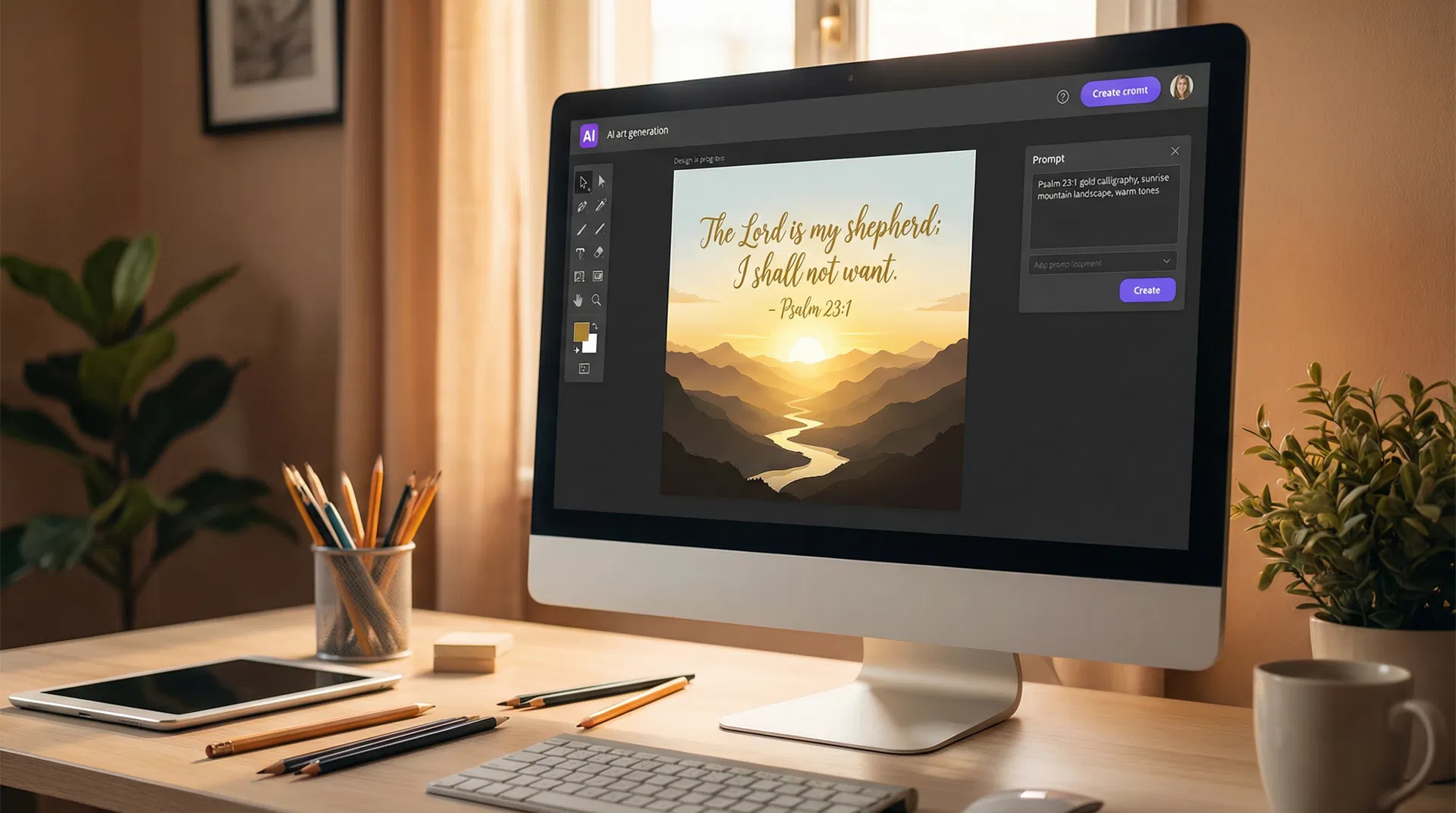
Example prompt for Suno: "Contemporary worship song based on Psalm 23, acoustic guitar and piano, female vocalist, peaceful and reassuring tone, verse-chorus-bridge structure, key of D, moderate tempo"
Step 5: Review Theologically Before using any AI-generated content in worship, review it carefully:
- Are the lyrics theologically accurate?
- Do they align with Scripture?
- Is the message appropriate for your congregation?
- Have you adapted them to reflect your authentic voice?
Step 6: Test with Your Worship Team Share the AI-generated demo with your worship team before using it in a service. Their feedback will help you refine the approach and ensure the music serves the congregation well.
Frequently Asked Questions
Can I use AI-generated worship music commercially? It depends on the platform. Soundraw and Mubert offer commercial licenses. Suno and Udio have more complex licensing terms — check their current policies before using AI-generated music in paid events or recordings.
Will AI replace worship musicians? No. AI can generate music, but it cannot lead a congregation in worship, respond to the Spirit's movement in a service, or build the relational trust that makes worship leadership effective. AI is a tool, not a worship leader.
Is AI worship music copyrightable? Copyright law around AI-generated content is still evolving. In the United States, the Copyright Office has ruled that purely AI-generated works without human creative input are not copyrightable. Works with significant human creative contribution may qualify. Consult a legal professional for your specific situation.
What if my congregation finds out we used AI? Transparency is always the best policy. Most congregations, when informed that AI was used for background music or demo tracks, respond positively — especially when they understand it helps the church serve them better with limited resources.
Are there AI tools specifically designed for Christian worship? Yes, several platforms are emerging with specifically Christian worship applications, including BibleWithLife's visual media tools. The AI worship music space is still developing, but purpose-built Christian tools offer the advantage of theologically vetted content.
The Bottom Line
AI worship song generators are not going to replace Spirit-led worship leaders or the sacred tradition of congregational singing. But they are genuinely useful tools for specific applications — especially for small churches with limited musical resources, worship leaders creating demos, and anyone needing instrumental background music.
The key is using these tools with theological intentionality: always reviewing AI-generated content carefully, being transparent with your congregation, and ensuring that the technology serves the worship rather than the worship serving the technology.
The same God who inspired David to write psalms on a harp can use any tool we bring to Him in faith and creativity.
Looking for visual resources to complement your worship? Explore BibleWithLife's cinematic Scripture wallpapers and free sermon kits — designed to help your church communicate the Gospel with excellence.
Did this article bless you? Share it!
For Pastors & Church Leaders
Bring This Story to Life in Your Church
Cinematic sermon visuals, ready-to-use slides, and discussion guides — crafted for busy pastors who want depth without the hours.
Free 7-Day Journey
Walk With Jesus — Day by Day
7 cinematic devotionals on the life of Christ, delivered to your inbox. One story, one verse, one truth per day.
No spam. Unsubscribe anytime.