Bible Study Guide
20 ChatGPT Bible Study Prompts for Deeper Scripture Engagement
Free 7-Day Journey
Go Deeper Into Scripture
7 cinematic devotionals delivered to your inbox — one story, one verse, one life-changing truth per day.
No spam. Unsubscribe anytime.
Published: March 2026 | Category: Church Technology
ChatGPT has become one of the most widely used tools in ministry — but most pastors and Bible students are barely scratching the surface of what it can do. With the right prompts, ChatGPT can function as a tireless research assistant, a patient theology tutor, and a creative collaborator for sermon preparation, small group studies, and personal devotions.
This guide provides 20 carefully tested prompts organized by use case, along with tips for getting the most accurate and theologically grounded responses.
Before You Start: A Word on Using AI for Bible Study
ChatGPT is a powerful tool, but it is not a theologian, a pastor, or a substitute for the Holy Spirit's illumination. Use these prompts as a starting point for deeper study — not as a final authority. Always cross-check AI-generated insights with trusted commentaries, your church's doctrinal standards, and the broader context of Scripture.
With that foundation in place, here are 20 prompts that will genuinely transform your Bible study experience.
Category 1: Understanding a Passage in Context (5 Prompts)
These prompts help you understand what a passage meant to its original audience before applying it to today.
Prompt 1 — Historical and Cultural Background
"Explain the historical and cultural context of [passage, e.g., John 3:1-21]. What would a first-century Jewish audience have understood when they heard this? What cultural assumptions did Jesus and Nicodemus share?"
Prompt 2 — Original Language Word Study
"In [passage], the word translated as '[English word]' comes from the Greek/Hebrew '[word]'. Explain the range of meanings this word carries in its original language and how different translations handle it. What nuances are lost in English?"
Prompt 3 — Literary Genre and Structure
"What literary genre is [book of the Bible] — narrative, poetry, prophecy, epistle, apocalyptic? How should the genre affect how I interpret [specific passage]? What interpretive rules apply to this type of writing?"
Prompt 4 — Author's Intent
"Who wrote [book of the Bible], to whom, and why? What was the primary problem or question the author was addressing? How does understanding the author's purpose change how I read [specific passage]?"
Prompt 5 — Cross-References and Themes
"What are the key cross-references for [passage]? How does this passage connect to the broader biblical narrative — creation, fall, redemption, new creation? Where does this theme appear elsewhere in Scripture?"
Category 2: Sermon and Teaching Preparation (5 Prompts)
These prompts help pastors, teachers, and small group leaders prepare engaging, biblically grounded content.
Prompt 6 — Sermon Outline
"Create a three-point expository sermon outline for [passage]. Each point should emerge directly from the text, not be imposed on it. Include a central proposition (what the passage is saying), the main points, and suggested application questions for each point."
Prompt 7 — Sermon Illustrations
"I am preaching on [theme/passage]. Suggest five sermon illustrations — one from everyday life, one from history, one from nature, one from current events, and one from a personal experience scenario — that would help a congregation understand [specific concept]."
Prompt 8 — Discussion Questions for Small Groups
"Create 8 discussion questions for a small group study of [passage]. Include 2 observation questions (what does the text say?), 3 interpretation questions (what does it mean?), and 3 application questions (what does it mean for us today?). Make them accessible for people with no theological training."
Prompt 9 — Children's Ministry Lesson
"Adapt [passage or story] into a 20-minute Sunday school lesson for [age group, e.g., 6-8 year olds]. Include a simple explanation of the main truth, an activity or object lesson, and a memory verse. Use language appropriate for the age group."
Prompt 10 — Devotional for a Specific Life Situation
"Write a 300-word devotional based on [passage] for someone going through [specific situation, e.g., job loss, grief, anxiety, a major life decision]. Connect the biblical truth to their experience and end with a prayer."
Category 3: Theological Deep Dives (4 Prompts)
These prompts are for those who want to explore doctrine, theology, and the big questions of faith.
Prompt 11 — Doctrinal Exploration
"Explain the doctrine of [e.g., justification by faith, the Trinity, the resurrection] as it appears in [specific passage or book]. What are the main interpretive positions among evangelical scholars? Where do they agree and where do they differ?"
Prompt 12 — Difficult Passages
"This passage is often considered difficult or controversial: [passage]. Summarize the main interpretive views, explain what makes it challenging, and describe how each view handles the difficulties. Which view has the strongest exegetical support and why?"
Prompt 13 — Comparing Translations
"Compare how five major Bible translations (ESV, NIV, NASB, NLT, KJV) render [passage]. Where do they differ significantly? What do the translation choices reveal about how translators understood the original text? Which translation is most accurate for this passage and why?"
Prompt 14 — Theology of a Biblical Book
"What is the central theological message of [book of the Bible]? What does this book uniquely contribute to our understanding of God, humanity, salvation, and the Christian life? How does it fit into the overall story of Scripture?"
Category 4: Personal Devotion and Spiritual Growth (3 Prompts)
These prompts help individuals apply Scripture to their own lives in a personal, reflective way.
Prompt 15 — Lectio Divina Style Reflection
"Guide me through a slow, meditative reading of [short passage, e.g., Psalm 23]. First, read it aloud with me (repeat the text). Then ask me three reflective questions to help me encounter God in this passage. Finally, suggest a simple way to carry this truth into my day."
Prompt 16 — 30-Day Reading Plan
"Create a 30-day Bible reading plan focused on the theme of [theme, e.g., God's faithfulness, prayer, forgiveness, identity in Christ]. Include one passage per day, a one-sentence focus for each day, and a brief reflection question. Organize it to build progressively from foundational to deeper passages."
Prompt 17 — Prayer Based on Scripture
"Write a prayer based on [passage], using the language and imagery of the text. The prayer should be personal (first person), honest about human struggle, and end with confident trust in God. Make it suitable for use in personal devotions."
Category 5: Creative and Evangelistic Uses (3 Prompts)
These prompts help churches create content that reaches people outside the church.
Prompt 18 — Social Media Caption
"Write 5 social media captions for [passage or verse]. Each should be under 150 characters, include the verse reference, and be written in a tone that is [choose: encouraging / challenging / reflective / joyful]. Suggest relevant hashtags for each."
Prompt 19 — FAQ for Seekers
"A non-Christian friend asked me: '[common question, e.g., Why does God allow suffering? / What makes Jesus different from other religious teachers? / Is the Bible reliable?]' Help me write a thoughtful, respectful 300-word response that is honest about the complexity of the question but points toward the Christian answer. Avoid jargon."
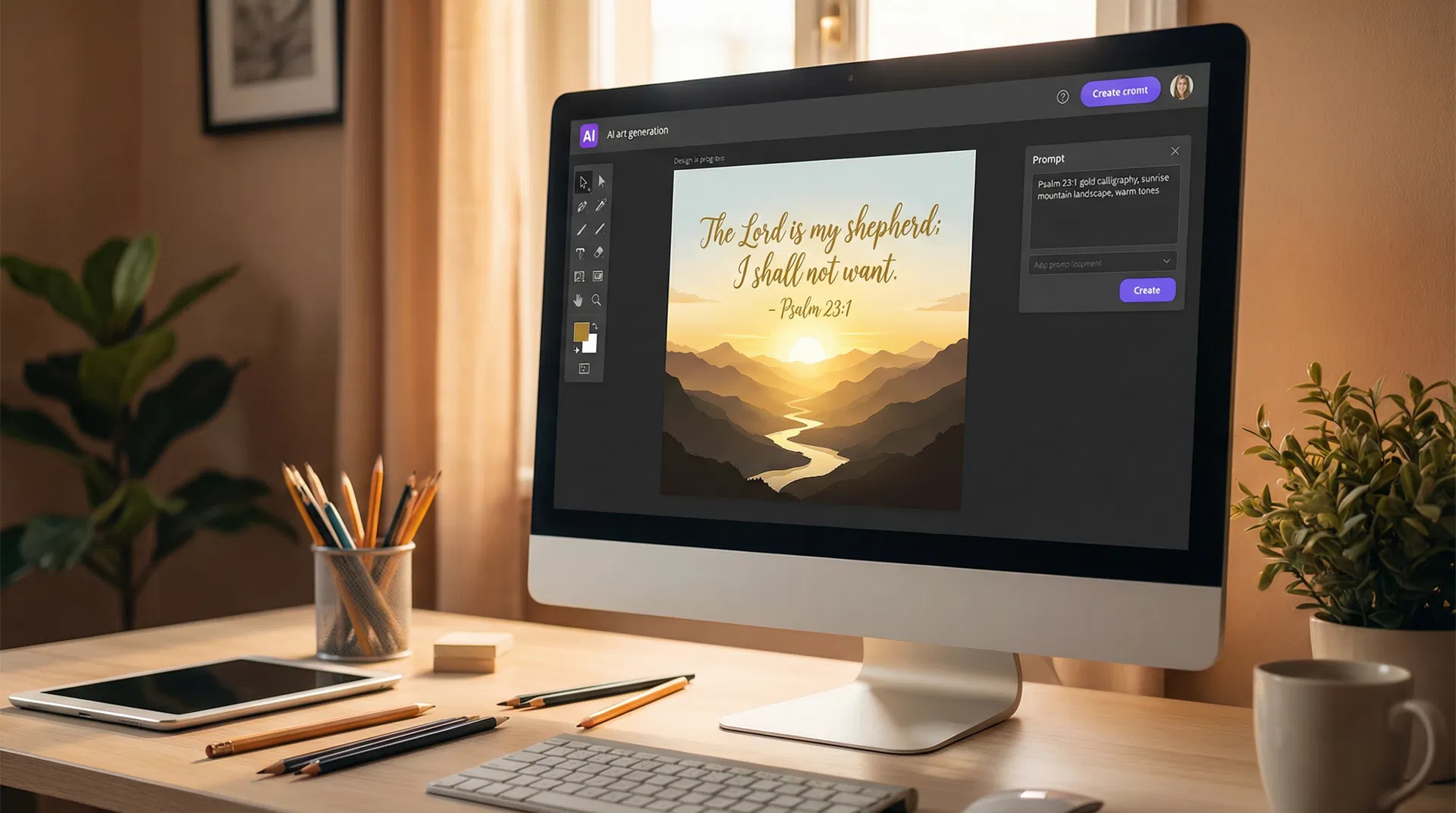
Prompt 20 — Scripture Art Caption
"I am creating a Scripture wallpaper image featuring [verse]. Write a 2-3 sentence caption that explains the verse's meaning, its context in the Bible, and why it is meaningful for daily life. Keep it accessible for someone who is not a regular Bible reader."
Tips for Better Results with ChatGPT Bible Study
Be specific about the translation. If you want ESV-based responses, say so. ChatGPT defaults to a blend of translations, which can be confusing.
Specify your audience. "Explain this for a new believer" produces very different results than "explain this for a seminary student." Telling ChatGPT who you are and who you are teaching dramatically improves output quality.
Ask for multiple options. Instead of accepting the first sermon outline or illustration, ask: "Give me three different approaches to this passage" and choose the one that resonates most.
Verify theological claims. ChatGPT can make confident-sounding errors on fine points of theology. Always check significant doctrinal claims against a trusted commentary or your pastor.
Use it iteratively. The best results come from a conversation, not a single prompt. Start with a broad question, then drill down: "Tell me more about that second point" or "How would a Reformed theologian respond to that interpretation?"
Frequently Asked Questions
Is it wrong to use ChatGPT for Bible study? Using AI as a study tool is no more problematic than using a concordance or Bible dictionary. The key is to remain the active learner — using AI to surface information and generate questions, while you do the work of prayerful reflection and application.
How accurate is ChatGPT on theology? ChatGPT is generally reliable on widely agreed-upon theological topics and historical facts. It is less reliable on fine doctrinal distinctions, denominational nuances, and very recent theological developments. Always cross-check important claims.
Can I use ChatGPT to write my entire sermon? You can use it for research, outlines, and illustrations — but a sermon that is entirely AI-generated lacks the pastoral heart and personal application that makes preaching transformative. Use AI to prepare more thoroughly, then let your own voice and the Spirit's leading shape the final message.
Conclusion
ChatGPT is not a replacement for prayerful, Spirit-led engagement with Scripture. But used wisely, it can help you study more deeply, prepare more thoroughly, and communicate more clearly. The 20 prompts in this guide are starting points — adapt them to your own context, your congregation's needs, and the specific passage you are studying.
The goal is always the same: to know God more fully through His Word, and to help others do the same.
Looking for a beautiful way to engage with Scripture daily? Explore BibleWithLife Reader — free Bible reading paired with stunning Scripture wallpapers for daily meditation.
Did this article bless you? Share it!
For Pastors & Church Leaders
Bring This Story to Life in Your Church
Cinematic sermon visuals, ready-to-use slides, and discussion guides — crafted for busy pastors who want depth without the hours.
Free 7-Day Journey
Walk With Jesus — Day by Day
7 cinematic devotionals on the life of Christ, delivered to your inbox. One story, one verse, one truth per day.
No spam. Unsubscribe anytime.