Ministry Leadership
Should Pastors Use AI to Write Sermons? A Biblical and Practical Answer
TL;DR
AI can legitimately assist sermon research, illustration brainstorming, and editing. However, using AI to write full sermons raises concerns about pastoral authenticity, the Holy Spirit's work of illumination, and congregational trust. The best approach uses AI as a research tool while maintaining deep personal engagement with the text, prayer, and pastoral knowledge of the congregation.
Free 7-Day Journey
Go Deeper Into Scripture
7 cinematic devotionals delivered to your inbox — one story, one verse, one life-changing truth per day.
No spam. Unsubscribe anytime.
Should Pastors Use AI to Write Sermons? A Biblical and Practical Answer
Few questions in ministry circles generate more heat right now than this one. In the span of two years, AI sermon tools have gone from curiosity to controversy to commonplace. A 2025 survey found that 64% of pastors now use AI for sermon preparation in some form. Yet the ethical, theological, and pastoral dimensions of this practice remain deeply contested.
This article does not offer a simple yes or no. Instead, it offers a framework — rooted in Scripture, pastoral theology, and practical wisdom — for thinking through one of the most pressing questions facing the contemporary church.
What Pastors Are Actually Doing
Before addressing the ethics, it is worth understanding the reality. When pastors say they "use AI for sermons," they mean very different things:
- Research assistance: Using AI to quickly surface commentaries, cross-references, historical context, and theological summaries
- Outline generation: Asking AI to suggest a sermon structure or three-point outline for a given text
- Illustration sourcing: Using AI to find or generate stories, analogies, and contemporary examples
- Draft writing: Having AI write a full sermon draft that the pastor then edits and personalizes
- Full delegation: Preaching an AI-generated sermon with minimal or no personal modification
These represent a spectrum from clearly acceptable to deeply problematic. The question is not simply "AI or no AI" but "which uses, in what ways, with what level of pastoral engagement?"
The Case for Thoughtful AI Assistance
Time and Bandwidth
The average pastor of a small-to-medium church is responsible for preaching, pastoral care, administration, counseling, community engagement, and family life — often with little or no staff support. The research phase of sermon preparation, which can consume 10–15 hours per week, is a genuine burden. AI tools that can rapidly surface relevant commentaries, theological positions, and historical context free up time for the dimensions of sermon preparation that require the pastor's unique presence: prayer, reflection, and pastoral application.
Accessibility for Smaller Churches
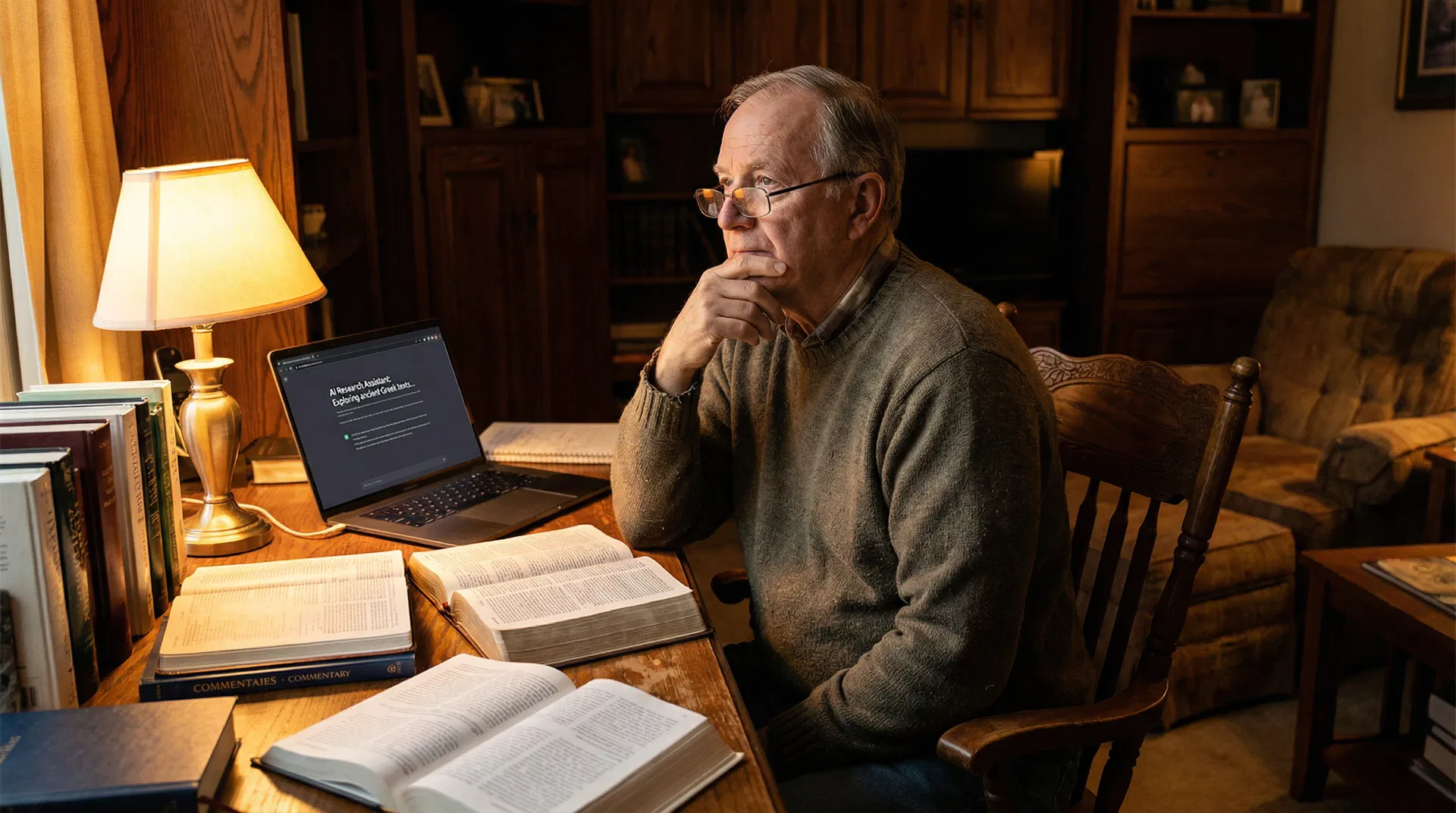
Many churches — particularly in rural areas, developing nations, and church plants — are led by bi-vocational pastors who have limited access to theological libraries, seminary training, or peer support. For these leaders, AI tools can provide access to a depth of biblical scholarship that was previously unavailable. This is not a shortcut; it is a leveling of the playing field.
The Precedent of Tools
Pastors have always used tools. Commentaries, concordances, Bible dictionaries, sermon illustration books, and homiletics software are all tools that assist sermon preparation. The printing press itself was a technological disruption that transformed how pastors prepared and delivered God's Word. AI is a more powerful tool, but it is a tool nonetheless — and the question of how to use it wisely is the same question the Church has always faced with new technology.
The Case for Serious Caution
The Sermon Is a Pastoral Act
The sermon is not primarily a content delivery mechanism. It is a pastoral act — the shepherd speaking to his specific flock, in a specific moment, from a specific place of prayer and spiritual discernment. The congregation gathered on Sunday morning is not receiving a lecture on biblical theology; they are receiving the Word of God mediated through a person who knows them, loves them, and has been praying for them.
This relational and spiritual dimension of preaching cannot be replicated by AI. A language model does not know that the couple in the third row is going through a divorce, that the teenager in the back is wrestling with doubt, or that the congregation needs to hear a word of comfort rather than challenge this particular week. Pastoral preaching requires pastoral knowledge — and that knowledge comes from presence, relationship, and prayer.
The Holy Spirit's Work
Evangelical and Reformed theology has always insisted that preaching is not merely human communication but a Spirit-empowered event. The Westminster Larger Catechism speaks of the "Spirit of God" making "the reading, but especially the preaching of the Word, an effectual means of enlightening, convincing, and humbling sinners." This does not mean that God cannot use imperfect human instruments — He always has. But it does raise the question of whether the pastor's prayerful engagement with the text, the wrestling and the waiting, is itself part of the Spirit's work of preparation.
If a pastor outsources the hard work of exegesis and application to an AI system, are they positioning themselves to receive the Spirit's illumination? This is not a question with a simple answer, but it is a question that deserves serious reflection.
Authenticity and Trust
Congregations trust that the sermon they hear reflects their pastor's genuine engagement with God's Word. When a pastor stands in the pulpit and says "as I was studying this passage this week," the congregation reasonably assumes that the pastor actually studied the passage. If that study was primarily delegated to an AI, the claim is at best misleading and at worst a form of deception.
The Church of Jesus Christ of Latter-day Saints addressed this directly in a December 2025 handbook update, stating that AI "cannot replace the gift of divine inspiration or the individual work" required of ministry leaders. While this comes from a different theological tradition, the principle resonates across Christian denominations.
Theological Risk
AI language models are trained on vast amounts of text, including theologically heterodox, syncretistic, and false content. They can generate plausible-sounding theological statements that are subtly or seriously wrong. A pastor who does not have the theological formation to identify these errors is at risk of preaching AI-generated heresy to their congregation.
A Practical Framework: The Five Questions
Before using AI in sermon preparation, ask these five questions:
1. Am I using AI to enhance my engagement with the text, or to replace it? AI that helps you go deeper into a passage — surfacing commentaries you would not otherwise have access to, suggesting cross-references, explaining historical context — enhances your engagement. AI that writes the sermon so you do not have to engage with the text replaces it.
2. Have I prayed through this passage myself, before and after using AI tools? The pastor's prayer life is the foundation of pastoral preaching. AI cannot pray. If AI tools are being used before the pastor has spent time in prayer with the text, the order is wrong.
3. Does the sermon reflect my pastoral knowledge of this congregation? An AI-generated sermon is generic by nature. It does not know your congregation. Before preaching, ask whether the sermon has been shaped by your specific knowledge of the people you are serving.
4. Am I being transparent with my congregation? Different churches will have different standards here, but the general principle is that pastors should not claim personal work they have not done. If AI tools contributed significantly to a sermon, consider how to be appropriately transparent about that.
5. Would I be comfortable if my congregation knew exactly how I prepared this sermon? This is the pastoral conscience test. If the answer is no, reconsider your approach.
What the Best Pastors Are Doing
The most thoughtful ministry leaders are finding a middle path: using AI as a research and brainstorming tool while maintaining deep personal engagement with the text. A typical workflow might look like this:
- Personal study first. Read the passage multiple times, pray, and write initial observations before opening any AI tool.
- AI-assisted research. Use AI to surface commentaries, historical context, and cross-references that deepen your understanding.
- Personal outline. Write your own sermon outline based on your study and pastoral knowledge of your congregation.
- AI for illustrations. Use AI to brainstorm contemporary illustrations or analogies, then select and personalize the ones that fit.
- Personal writing. Write the sermon yourself, in your own voice, from your own pastoral heart.
- AI for editing. Use AI to check for clarity, grammar, and flow.
This approach uses AI's genuine strengths — rapid research, breadth of knowledge, language assistance — while preserving the irreplaceable elements of pastoral preaching.
Conclusion
The question is not whether AI is permissible in sermon preparation. It is how AI can serve the pastor's calling without displacing it. Used wisely, AI can free up time, deepen research, and support the communication of God's Word. Used unwisely, it can hollow out the pastoral act of preaching, erode congregational trust, and introduce theological error.
The pastor who prays, studies, and preaches with integrity — using every good tool available while remaining the shepherd of a specific flock — is the pastor the Church needs in the age of AI.
Explore Bible with Life's Scripture reading tools and daily devotional resources designed to support your personal study and sermon preparation.
Did this article bless you? Share it!
For Pastors & Church Leaders
Bring This Story to Life in Your Church
Cinematic sermon visuals, ready-to-use slides, and discussion guides — crafted for busy pastors who want depth without the hours.
Free 7-Day Journey
Walk With Jesus — Day by Day
7 cinematic devotionals on the life of Christ, delivered to your inbox. One story, one verse, one truth per day.
No spam. Unsubscribe anytime.